Loading...
Our Homeschool Curriculum: A Roadschooling Overview
When we tell people we homeschool our kids while traveling full time they often ask "How do you know what to teach them? Do you use a program?"
Because we roadschool, our approach needs to be flexible, portable, and rooted in real experiences. We want our kids to build strong foundational skills and to see learning as something that happens everywhere—not just at a table with a workbook.
Our homeschool rhythm combines high quality curriculum, real-world experiences, and a lot of unstructured time for our kids to learn through creative play and exploration.
Logic of English: A Strong Literacy Foundation
For reading and spelling, we use Logic of English. This program has been a wonderful fit for our family because it’s:
- Explicit and systematic
- Rooted in phonics and spelling rules
- Supportive for different learning styles
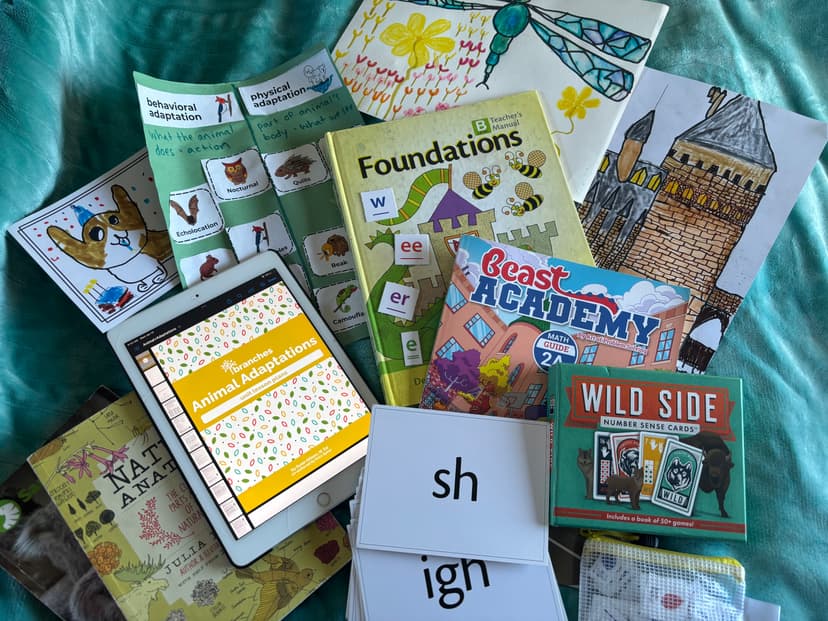
Early reading was a struggle for our oldest, who showed many signs of dyslexia, so we were on the hunt for a phonics-based curriculum that empowers students with dyslexia, giving them the skills and confidence to become effective readers. Logic of English gives our kids clear tools for decoding language, which builds confidence quickly. Even while traveling, it’s easy to pull out a lesson, practice spelling patterns, or reinforce concepts through games and by using the phonogram cards, a set of cards that details every single sound in the English language.
Even as an adult who identifies as a strong reader and has a background in elementary education, I have learned a lot about the English language through this program.
Khan Academy Math: Mastery at Your Own Pace
For math, we primarily use Khan Academy, a free online math curriculum.
What we love most is the mastery‑based approach. Kids can move at their own pace, review concepts when needed, and cruise ahead when they’re feeling motivated. Being a fully online curriculum also means it takes up no space and adds no weight to our travel trailer.
To complement screen‑based learning, we also use Wild Side Number Sense Cards and Beast Academy puzzle books.
- Wild Side Number Sense Cards help build strong mental math and number sense through short, playful practice that’s easy to pull out anywhere—perfect for travel days.
- Beast Academy puzzle books add depth, challenge, and joyful problem‑solving. They encourage flexible thinking, persistence, and a love of math beyond worksheets.
We pair Khan Academy with real‑life math whenever possible:
- Budgeting for groceries
- Measuring ingredients while cooking and baking
- Distances, travel times and fuel efficiency
- Measurements and problem solving involved in trailer repairs and maintenance
Math becomes something they use, not just something they complete.
Branches for Science: Living, Hands-On Learning
Science in our homeschool comes from Branches, a beautiful curriculum created by Busy Toddler founder Susie Allison. What drew us to Branches is how it weaves exploration, nature, and curiosity with intentional, thoughtful structure. Susie’s approach emphasizes observation and playful investigation, making science feel alive and accessible even when we’re on the road.
Branches encourages:
- Experiments that grow out of real questions
- Observation and wonder as central habits of a learner
- Discussions that stretch thinking and build scientific confidence
- Integrates scientific concepts with rich language, poetry, reading comprehension, grammar and art
We often adapt lessons to match our travel plans. We are currently studying the Animal Adaptations unit while staying in the San Diego area so we can pair it with multiple visits to the San Diego Zoo and San Diego Safari Park. Branches gives us a flexible framework that honors the questions that naturally emerge from our travels.
Field Trips as Curriculum
Field trips aren’t an “extra” for us—they** are a core part of our homeschool.
Museums, national parks, historical sites, cultural and visitor centers, ranger talks, zoos, aquariums, farmers markets—these experiences form the backbone of our learning.
Instead of trying to replicate school at home, we ask:
- What can we learn by experiencing this place together?
- What questions does it spark?
- How can we connect this experience to reading, writing, science, math and history?
Our "field trips as curriculum" approach is what inspired us to create Roadschool Atlas in the first place.
Roadschool Atlas: Writing to Capture Learning
We created Roadschool Atlas because we wanted a meaningful way for our kids to process and reflect on what they experience.
Roadschool Atlas is where our kids:
- Write about field trips and travel days
- Record observations and reflections
- Practice narration and storytelling
- Connect learning across subjects
Writing becomes purposeful because it’s grounded in lived experience. Instead of generic prompts, our kids are writing about places they’ve stood, things they’ve touched, and moments that mattered.
We’re currently working on expanding this into the Roadschool Atlas Projects, designed to help families turn travel and field trips into cohesive, thoughtful learning projects.
Brave Writer: Writing Inspired by Julie Bogart
Our writing approach is heavily inspired by Brave Writer, founded by Julie Bogart. Her book Help! My Kid Hates Writing changed our approach to writing, inspiring us to focus on daily low-stakes free writes to increase our kids confidence, stamina and creativity when it comes to writing.
We occasionally use the Dart curriculum to enrich our experience of family read alouds and combine reading comprehension with grammar, vocabulary and writing structure.
We are also planning on using the Partnership Writing curriculum more the second half of this homeschool year and are looking forward to diving into this set of creative writing projects that parents and children work on together.
We focus on:
- Gentle structure
- Strong models of good writing
- Collaboration and conversation
- Honoring each child’s voice
For writing we emphasize process—talking, thinking, revising, and growing confidence over time. Writing often grows out of shared experiences, read‑alouds, and reflecting on field trips and travel.
Typing Skills with EdClub’s TypingClub
We also include typing practice as part of our homeschool rhythm using EdClub’s TypingClub program. TypingClub is a web-based keyboarding curriculum that guides kids through structured lessons to build touch-typing skills, helping them type with confidence, speed, and accuracy.
TypingClub works well for us because it:
- Is self-paced, so kids can log in and work at a rhythm that fits their day.
- Includes a wide range of lessons—from beginners learning letter placement to advanced touch-typing practice.
- Gives real-time feedback on speed and accuracy, which helps them track progress and set goals.
We focus on short daily practice sessions to build lasting keyboard fluency that will serve them in writing, research, and creative projects.
Free-Form Art: Creativity Without an Agenda
Art in our homeschool is intentionally free-form. While our kids have taken a handful of in-person and online classes through Studio Sprout, we don’t follow a formal art curriculum most of the time. Instead, we make space for creativity to emerge naturally through materials, time, and freedom.
Our kids regularly engage in:
- Drawing and sketching
- Watercolor painting
- Making paracord and beaded bracelets
Our art supplies are always accessible and take up a significant portion of the overall storage space in our travel trailer. This kind of open-ended creativity supports fine motor skills, expression, confidence and has inspired both of our sons to become entrepreneurs—they both create and sell their art to neighbors and friends and at local kids markets when we have the opportunity to be part of one.
We see art not as a subject to master, but as a language—one our kids can return to again and again to process and reflect on their experiences, unwind, and create something that feels uniquely theirs.
Our Philosophy: Structure + Freedom
At its heart, our homeschool is a balance between child-led exploration and structured lessons to create a strong foundation of academics.
We believe in:
- Strong foundational skills
- Deep, meaningful experiences
- Following curiosity
- Allowing learning to unfold over time
Curriculum is a tool—not the goal. Our goal is curious, capable kids who know how to learn, ask questions, and engage with the world around them.
If you’re building your own homeschool or roadschool rhythm, I hope this gives you ideas—and permission—to blend structure with wonder.
Learning doesn’t have to be confined to one place. Sometimes the best classroom has wheels. 🚐✨